


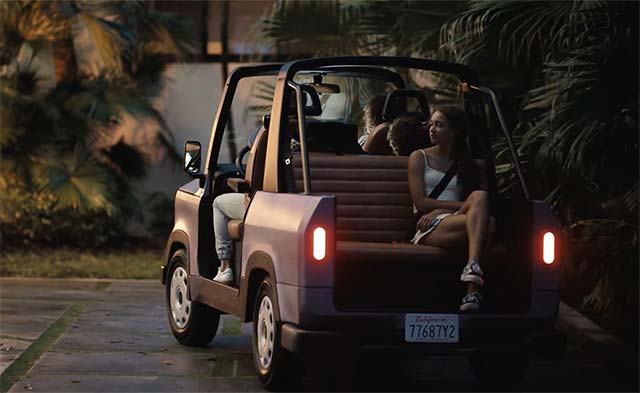
Miami-based startup Chip Motors has introduced an affordable electric vehicle designed for short daily trips, blending the practicality of a golf cart with the functionality of a neighborhood electric vehicle. Starting at just $15,000, the new Chip promises over 100 miles of range, seating for up to six passengers, and an innovative remote-driving service that could redefine urban mobility.
As electric vehicle adoption cotinues to grow, a new segment is emerging for compact, low-speed EVs built specifically for local transportation. Chip Motors believes its first model, simply called Chip, is positioned to become a compelling alternative to golf carts and oversized SUVs for everyday errands.
A New “Life Utility Vehicle” Category
Chip Motors describes its vehicle as a Life Utility Vehicle (LUV)—a name intended to emphasize its role in everyday activities such as school runs, grocery shopping, beach trips, and neighborhood commuting.
Despite the new branding, the vehicle fits squarely within the existing Low-Speed Vehicle (LSV) category in the United States. Federal regulations limit LSVs to a maximum speed of 25 mph, allowing them to operate on roads with speed limits of 35 mph or less, subject to state and local regulations.
The growing popularity of street-legal golf carts in warm-weather communities has created demand for vehicles that offer greater comfort, safety, and practicality while remaining inexpensive to own and operate. Chip Motors aims to fill that gap with a purpose-built electric vehicle rather than a modified golf cart.
Designed for Short Daily Trips
The open-air EV combines styling cues from classic utility vehicles with a simple, modern design.
Available in four-seat and six-seat configurations, the Chip starts at:
– $15,000 (estimated MSRP) for the four-seat model
– $18,000 (estimated MSRP) for the six-seat version
Reservations are now open with a fully refundable $250 deposit, while first customer deliveries are expected to begin in 2027, initially in Florida before expanding to additional markets.
Unlike conventional compact EVs, Chip features:
– Open-air design with removable roof options
– Plastic composite body panels
– Washable “hose-down” interior
– Standard LATCH child-seat anchors
– Front trunk (frunk) for extra cargo
– Higher ground clearance
– Roll bar for added protection
A wide range of accessories will also be available, including:
– Air conditioning
– Hard or soft roof
– Roof rack
– Lift kit
– Surfboard rack
– Apple CarPlay and Android Auto
– Integrated navigation
– Entertainment-equipped front trunk with speakers and display
100+ Miles of Electric Range
For a vehicle limited to neighborhood speeds, efficiency is one of Chip’s strongest selling points.
Chip Motors estimates more than 100 miles of driving range from a battery pack believed to be around 15 kWh, using durable lithium iron phosphate (LFP) battery chemistry paired with efficient in-wheel electric motors.
Charging options include:
– Standard 110-volt household outlet for overnight charging
– 240-volt charging in just a few hours
– NACS charging port for compatible Level 2 public charging stations
Final charging specifications will be confirmed closer to production.
Why Chip Thinks Americans Are Ready for Smaller EVs
While compact city cars dominate many European and Japanese cities, the U.S. market has traditionally favored larger SUVs and pickup trucks.
Chip Motors believes that trend is beginning to shift for short-distance driving.
The company points to the rapid rise of street-legal golf carts in beach towns, retirement communities, and suburban neighborhoods, where many owners are replacing second vehicles with compact electric transportation for local trips.
Rather than adapting a golf cart for road use, Chip was engineered specifically for public roads within the LSV category, offering greater capability, improved storage, more passenger space, and a broader range of customization options.
Chip Go Uses Remote Human Drivers
One of the most talked-about features is Chip Go, although it is frequently misunderstood.
Some early reports described the system as autonomous driving, but Chip Motors has clarified that Chip Go is not self-driving technology.
Instead, it uses teleoperation, allowing trained remote operators to temporarily take control of the empty vehicle.
Initially, Chip Go will only operate when no passengers are inside the vehicle. The company says trained operators located in the United States will control the vehicle remotely and that Chip Motors will assume responsibility while remote operators are driving.
Customers are expected to purchase remote-driving time through usage packages, although pricing has not yet been announced.
Long-Term Autonomous Driving Ambitions
Although Chip Go relies on remote human drivers today, the startup says the platform has been designed with future automation in mind.
The vehicle includes:
– Surround-view cameras
– Forward-facing radar
– Connectivity designed to support future software upgrades
Notably absent is lidar, a sensor commonly used by many autonomous vehicle developers. Chip Motors believes its intended low-speed operating environment allows it to pursue a simpler hardware approach while leaving room for future enhancements.
The company ultimately hopes to license Level 4 autonomous driving technology as it becomes commercially viable, though achieving fully autonomous operation remains a long-term objective rather than an available feature.
A Different Take on Affordable Electric Mobility
Chip enters a niche already occupied by neighborhood electric vehicles such as GEM and several street-legal golf cart manufacturers, but it distinguishes itself with automotive-inspired design, extended driving range, extensive customization, and an ambitious remote-driving service.
At $15,000, it also undercuts most traditional electric cars by a significant margin, targeting buyers who want an inexpensive second vehicle dedicated to short local journeys instead of full highway capability.
Whether the combination of affordability, practical design, and remote teleoperation proves successful remains to be seen, but Chip Motors is betting that many Americans no longer need a full-size SUV for every trip—and that a purpose-built electric LSV could become the smarter choice for everyday neighborhood driving.
[source: InsideEVs, Forbes]


