
The BMW Group is advancing its hydrogen mobility strategy with a breakthrough storage solution for the BMW iX5 Hydrogen.
The newly developed “Hydrogen Flat Storage” system significantly improves packaging efficiency while extending driving range to as much as 750 km (385 miles), marking a major step forward for fuel cell vehicles.
Smarter Packaging, Longer Range
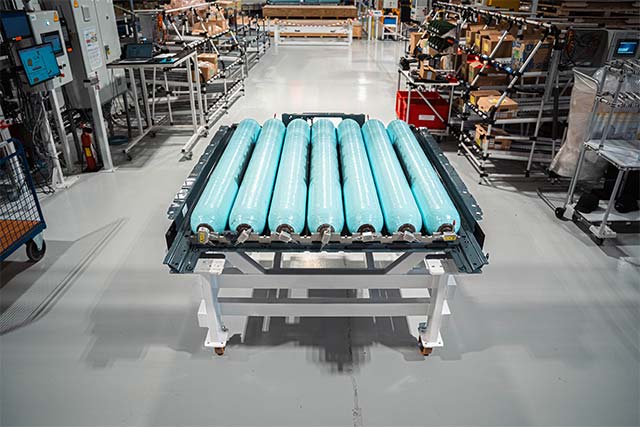
At the core of the innovation is a flat, space-saving tank design that integrates seamlessly into the vehicle architecture. Unlike traditional cylindrical hydrogen tanks, the system uses seven carbon-fibre reinforced high-pressure tanks arranged in a compact, modular layout.
These tanks are connected in parallel and housed within a robust metal frame, forming a single enclosed unit controlled by a central valve. This configuration not only optimizes space utilization but also enables the system to store at least seven kilograms of hydrogen.
The result is a meaningful increase in driving range—bringing the iX5 Hydrogen closer to parity with conventional long-distance vehicles—while maintaining one of hydrogen’s biggest advantages: refuelling in under five minutes.
Safety and Efficiency at the Forefront
Operating at 700 bar pressure, the hydrogen tanks are integrated into the vehicle structure, providing additional mechanical protection and enhancing safety. The design also contributes to multiple patent filings, underlining its technical significance.
Importantly, the flat storage system is fully compatible with BMW’s Gen6 high-voltage battery. This allows the hydrogen powertrain to coexist without compromising cabin or cargo space—an area where many alternative powertrains face trade-offs.
A True BMW Driving Experience
The iX5 Hydrogen combines its advanced storage system with next-generation fuel cell technology and a high-voltage battery to deliver the performance expected from the brand. It also benefits from BMW’s latest drivetrain innovations, including the “Heart of Joy” control software and BMW Dynamic Performance Control.
This integrated approach ensures that hydrogen-powered models retain the driving dynamics and responsiveness associated with BMW vehicles, rather than positioning them as purely efficiency-focused alternatives.
Flexible Production for a Multi-Energy Future
One of the standout aspects of the new system is its compatibility with BMW’s flexible production strategy. The same assembly lines used for the BMW X5 can accommodate multiple powertrain variants, including battery-electric, plug-in hybrid, internal combustion, and hydrogen fuel cell models.
Standardized component geometries help reduce complexity and manufacturing costs while improving scalability. This approach is expected to support broader deployment of hydrogen models across BMW’s production network, with a wider rollout targeted for 2028.
Hydrogen as a Strategic Pillar
BMW continues to pursue a technology-neutral strategy, recognizing that no single solution will dominate the future of mobility. Hydrogen fuel cell vehicles offer several distinct advantages, including long range, rapid refuelling, and reduced reliance on specific raw materials or charging infrastructure.
Projects such as HyPowerDrive—supported by the German government and regional partners—are accelerating development and bringing hydrogen technology closer to large-scale adoption.
The Bigger Picture
With innovations like the Hydrogen Flat Storage system, the BMW iX5 Hydrogen demonstrates how fuel cell technology can overcome traditional limitations. By combining efficient packaging, strong performance, and production flexibility, BMW is positioning hydrogen as a viable complement to battery-electric vehicles in the transition to zero-emission mobility.


