
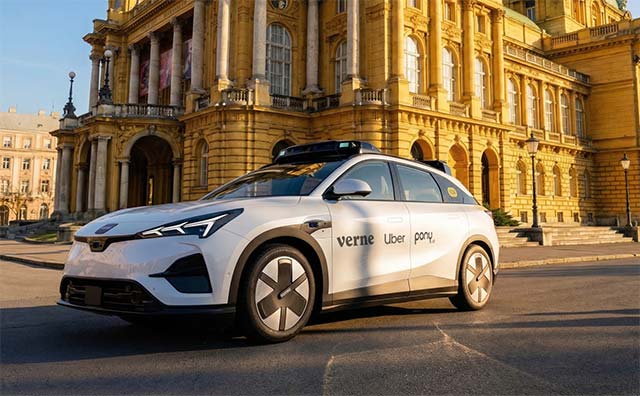
A major step toward autonomous mobility in Europe is taking shape as Uber Technologies, Pony.ai, and Verne join forces to deploy the continent’s first commercial robotaxi service.
The initiative will begin in Zagreb, where early deployment activities and real-world testing are already underway.
A Three-Way Partnership to Scale Autonomous Mobility
The collaboration brings together three complementary strengths to accelerate commercialization. Pony.ai contributes its advanced autonomous driving technology, Uber integrates the service into its global ride-hailing platform, and Verne oversees fleet ownership and operational execution.
This structured approach creates a scalable framework designed to expand beyond Zagreb into other European cities. Over the next few years, the partners aim to deploy thousands of robotaxis, signaling a significant shift in urban mobility across the region.
Gen-7 Autonomous Technology Enters European Roads
At the core of the rollout is Pony.ai’s latest Gen-7 autonomous driving system. The technology is currently being tested on public roads in Zagreb using the Arcfox Alpha T5 Robotaxi, marking one of the first real-world validations of large-scale autonomous driving in Europe.
With preparations for fare-based services already in progress, Zagreb is emerging as a pioneering market for robotaxi operations, potentially setting the standard for other European cities.
Verne to Lead Regulatory and Market Readiness
Verne plays a central role in navigating Europe’s complex regulatory environment. The company is responsible for securing approvals and ensuring market readiness while coordinating deployment across both its own platform and Uber’s network.
This unified operational model is designed to deliver consistent safety, performance, and user experience—key factors in building public trust and enabling large-scale adoption.
Strategic Investment and Long-Term Expansion
As part of the agreement, Uber plans to invest in Verne, reinforcing its commitment to autonomous mobility and supporting future growth. The partnership highlights a broader industry trend: collaboration is becoming essential to scaling autonomous transportation globally.
By combining proven technology, operational expertise, and a massive user platform, the alliance positions itself to accelerate the transition from pilot programs to fully commercial robotaxi services.
Europe’s Autonomous Future Begins in Zagreb
The launch in Zagreb represents more than just a new mobility service—it signals the beginning of a broader transformation in how people move through cities. With ongoing testing, regulatory progress, and infrastructure development, Europe is edging closer to widespread adoption of autonomous ride-hailing.
If successful, this initiative could redefine urban transportation, reduce costs, and pave the way for cleaner, more efficient mobility solutions across the continent.


