
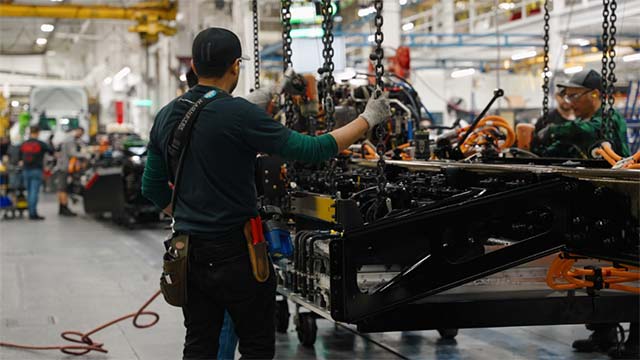
Daimler Truck North America (DTNA) is committed to reducing the company’s overall carbon footprint by integrating a comprehensive circular economy approach across its operations. This strategy emphasizes repairing, remanufacturing, repurposing and recycling lithium-ion battery materials used in all DTNA electric vehicles.
With goals to maximize battery lifespans and reduce material waste, the circular economy approach strives to extend the usability of rare-earth materials and products, thereby tackling global sustainability challenges. Leveraging advanced technology, DTNA can discern when a lithium-ion battery no longer meets DTNA’s high standards required for vehicle use. This insight guides the decision on the optimal process to maximize materials for a second life, with repair taking precedence whenever possible.
While batteries receive significant attention due to their use of rare-earth metals like cobalt and nickel, DTNA’s approach extends to all components of the EV product.
“As part of our commitment to maximizing material life cycles, we meticulously assess environmental and ethical implications from sourcing to post-production,” said Rakesh Aneja, vice president and chief of Zero-Emission Transformation Group at DTNA. “Our primary goal is to repair our lithium-ion battery materials and reduce the consumption of new resources.”
Remanufacture
When a battery or electric vehicle component is beyond simple repair, it enters the remanufacturing process at existing Detroit Diesel Remanufacturing locations across the U.S. like the recently expanded Hibbing facility with intended reuse in vehicles. This process involves partial disassembly, module replacement and rigorous testing for optimized reliability. All remanufactured products are updated with the latest technology and must meet or exceed new product standards to be reintroduced to the market.
Remanufactured products are a cost-effective solution that improves the total cost of ownership, benefiting both DTNA’s customers and the environment. Today, the primary EV components for remanufacturing are Detroit batteries and eAxles, with potential for further expansion in the future.
Repurpose
DTNA has partnered with Nuvation Energy to pilot a battery energy storage system (BESS) designed to assist in charging, peak shaving, backup storage and microgrid scenarios. This innovative solution enables DTNA to repurpose batteries that cannot be reused in a vehicle.
“We’re thrilled to announce the incorporation of DTNA’s first battery energy storage system units, designed by Nuvation Energy using Detroit battery modules, at Electric Island later this year,” continued Aneja. “Battery energy storage systems play a pivotal role in the electric vehicle ecosystem, given the escalating demand for charging infrastructure and limitations of the current power grid. As the number of EVs on the road increases, the existing grid capacity may struggle to meet charging demands. Energy storage systems alleviate this issue by facilitating off-peak charging, utilizing stored power when needed, and reducing reliance on the grid.”
Recycle
DTNA has created a process in partnership with Li-Cycle, a leading lithium-ion battery resource recovery company, to responsibly recycle critical battery-grade materials for batteries that reach the end of their life cycle. Li-Cyle uses an environmentally friendly and safe method that recycles batteries within a liquid-based solution, achieving up to a 95% recovery rate for returning critical materials back to the battery supply chain while producing minimal water discharge.
“This circular approach extends beyond just batteries,” concluded Aneja. “We are actively working to apply this concept to other facets of our product development, aiming to increase our utilization of reusable or recyclable materials. Our goal is to continue contributing positively to the preservation of our planet for future generations.”
Path to Net Zero Operations
Since 2006, DTNA has placed a high priority on establishing recycling solutions within its production facilities. Early initiatives, such as achieving ISO 14001 certification at every plant in the U.S. and Mexico by 2008 and Zero Waste to Landfill status at all plants by 2017, underscore DTNA’s commitment to sustainable practices. Not only does DTNA provide practical solutions for its production facilities, but it also communicates a clear recycling strategy to its customers from the outset.
In line with its sustainability goals, DTNA aims to achieve carbon neutrality for all new products and services from direct suppliers in Europe, the United States, and Japan by 2039. As early as 2020, the Portland Truck Manufacturing Plant, where the Freightliner eCascadia and eM2 are built, achieved CO₂-neutral production by reducing energy consumption and offsetting on-site emissions. DTNA further plans to achieve CO₂-neutral production at all its remaining truck manufacturing plants by 2025.


