

The electrified namesake of the segment for large vans – the new Mercedes-Benz eSprinter – will soon hit the roads. The added value for customers is evident in its versatility and flexibility: Two body shapes and lengths, three battery sizes and a high payload make the new eSprinter the ideal vehicle for a wide range of applications.
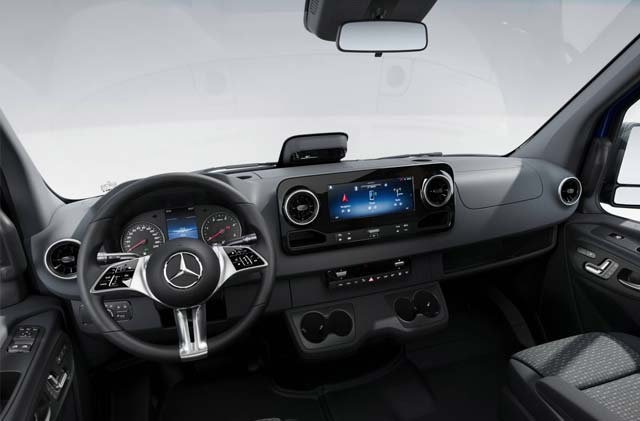
Depending on their needs, the customer can opt for more range or more payload. The panel van will be available to order from 16 January in combination with 56 kWh or 113 kWh of usable battery capacity. A version with 81 kWh will follow shortly. In addition, the new eSprinter will also be available as an open model for the first time at a later date. This makes the eSprinter an attractive basic vehicle for numerous new sectors as well as body and equipment manufacturers. In addition, it comes with a plus in intelligent, digital connectivity, for the first time with the MBUX multimedia system, enhanced safety and assistance systems as well as upgraded standard equipment. In addition, the eSprinter will be available with an optional trailer coupling.

Efficiency, range and load volume: This triad makes the new Mercedes-Benz eSprinter a versatile all-rounder. In addition, it brings a large number of technical innovations and is based on a new concept consisting of three modules. These allow the greatest possible freedom in the development and design of various extensions and bodies, which were previously only known from the conventionally powered Sprinter.
The front module, a uniformly designed stem, encompasses all high-voltage components and can be combined unchanged with all vehicle variants, regardless of wheelbase and battery size. The module for the space-saving integrated high-voltage battery is located in the underbody. The battery position between the axles, together with the robust battery housing, ensures optimal storage of the high-voltage battery, and the low centre of gravity has a positive influence on handling. The rear module with the electrically driven rear axle is used in all variants of the new eSprinter. The compact and powerful electric motor is also integrated into the rear module.
The new eSprinter demonstrated its efficiency during a test drive in which a pre-production vehicle of the new eSprinter panel van with a battery size of 113 kWh completed the route from Stuttgart to Munich and back – a route length of 475 kilometres – on a single battery charge and without recharging.
With regards to a practical vehicle configuration for CEP (courier, express and parcel service) use, an extra-long eSprinter with a high-roof was selected for this test drive.
The electrically driven rear axle in the new Mercedes-Benz eSprinter offers customers advantages in terms of vehicle lengths, maximum gross vehicle weight (up to 4.25 tonnes) as well as towing capacities (up to 2 tonnes) and load volume (maximum 14 m³). Accordingly, the new eSprinter is available in two body shapes and lengths as well as with an efficient electric motor in the output levels of 100 and 150 kilowatts peak each. The new permanent magnet synchronous motor (PSM) is characterized by a particularly high efficiency. In addition, the thermal management has also been further developed. Customers can choose between three different battery sizes for the new eSprinter, depending on their individual requirements in terms of range and payload: a battery with a usable capacity of 113 kWh, 81 kWh or 56 kWh (81 kWh variant will be available to order later this year).
The electric range, calculated on a simulation based on the WLTP cycle, will be up to 440 kilometres. According to simulations based on the WLTP City cycle, a range of up to 530 kilometres is possible for journeys in urban areas. With these ranges, the vehicle is also ideal for longer journeys. The battery cells are made of lithium iron phosphate and are free of cobalt and nickel. The energy recovery in overrun and braking mode (recuperation) ensures optimised and efficient driving. The intensity of the recuperation can be adjusted individually via shift paddles behind the steering wheel. A particularly efficient and comfortable driving style is made possible by the new DAUTO automatic recuperation system in the eSprinter. According to the maxim “drive with foresight and save energy”, information from the radar, camera and navigation data is networked and the strength of the recuperation is adapted to the situation automatically in real time. In addition, the ECO Assist can support anticipatory driving: Depending on the equipment and country, the system analyzes whether a vehicle is driving ahead, what the speed limit is or whether an incline is following and indicates when the foot should be taken off the accelerator in the instrument cluster. Depending on the situation, it then selects the appropriate recuperation strength. In addition, three drive modes help you choose between maximum comfort or maximum range.
Like all electric vans from Mercedes-Benz, the new eSprinter is capable of both alternating current (AC) and direct current (DC) charging. The on-board charger can be charged with direct current at up to 115 kilowatts (optional) at a fast-charging station. In concrete terms, this means: The battery with a capacity of 56 kWh is charged from 10 to 80 percent in around 28 minutes at a maximum of 115 kW. The battery with a usable capacity of 113 kWh needs around 42 minutes at a maximum of 115 kW. The Mercedes me Charge digital service is also available for the eSprinter. This gives customers access to one of the largest public charging networks in Europe with around 600,000 charging points – including the European fast-charging network IONITY.
Mercedes me Charge ensures a convenient charging experience and offers access to 1,150 different operators of public charging stations in Europe via a single charging contract. These include the Mercedes-Benz Charging Hubs, whose first European location was recently opened in Mannheim. With the Mercedes me Charge tariff system, customers can benefit from fixed prices that apply regardless of the charging station operator. In this way, Mercedes-Benz creates maximum cost transparency. Customers can adapt their tariff to their individual charging behaviour and optimise costs. At all stations, Mercedes me Charge enables charging with electricity from renewable energy sources.
For the new eSprinter, there will also be a B2B solution especially for corporate customers. This offers corporate and fleet customers the option of unifying vehicle and driver management as well as invoicing for the entire company.
The new eSprinter panel van with the 56 kWh battery starts at 71,388.10 euros (59,990 euros German net list price excluding 19% VAT). In the field of battery-electric vehicles, leasing is particularly relevant for customers: Up to 80 percent of commercial Mercedes-Benz eVans are leased. The new eSprinter panel van starts with a monthly leasing instalment of 690 euros.


